

The gap leadership already senses
Large specialty and batch chemical sites in India usually run serious infrastructure already: process historians, utility monitoring, periodic energy audits, ISO-aligned management systems, and corporate intensity targets on quarterly leadership reviews.
You also receive a monthly HT electricity bill that summarizes, in rupees, whether last month's operational choices were good enough.
Between those two realities sits a persistent gap. Systems record what happened. Dashboards show trends. Audit reports list opportunities. What rarely exists is a governed decision layer: who should act, on what evidence, with what expected financial and intensity outcome, and whether the next bill confirms it.
That is not a sensor failure. It is an operating model failure at the level of leadership accountability.
Monitoring solved visibility. It did not solve closure.
Industrial digitalization delivered real value: centralized data, better alarm discipline, stronger EHS traceability. For senior leadership, the same meeting still repeats every month:
Consumption was elevated in a period that already ended.
A cross-functional recommendation was discussed but not owned.
A sustainability metric moved, but the plant cannot tie it to verified operational actions.
The bill arrived after the window to intervene.
Advanced plants feel this acutely because they already invested in the visibility layer. Another chart does not change the meeting.
What a decision layer actually means
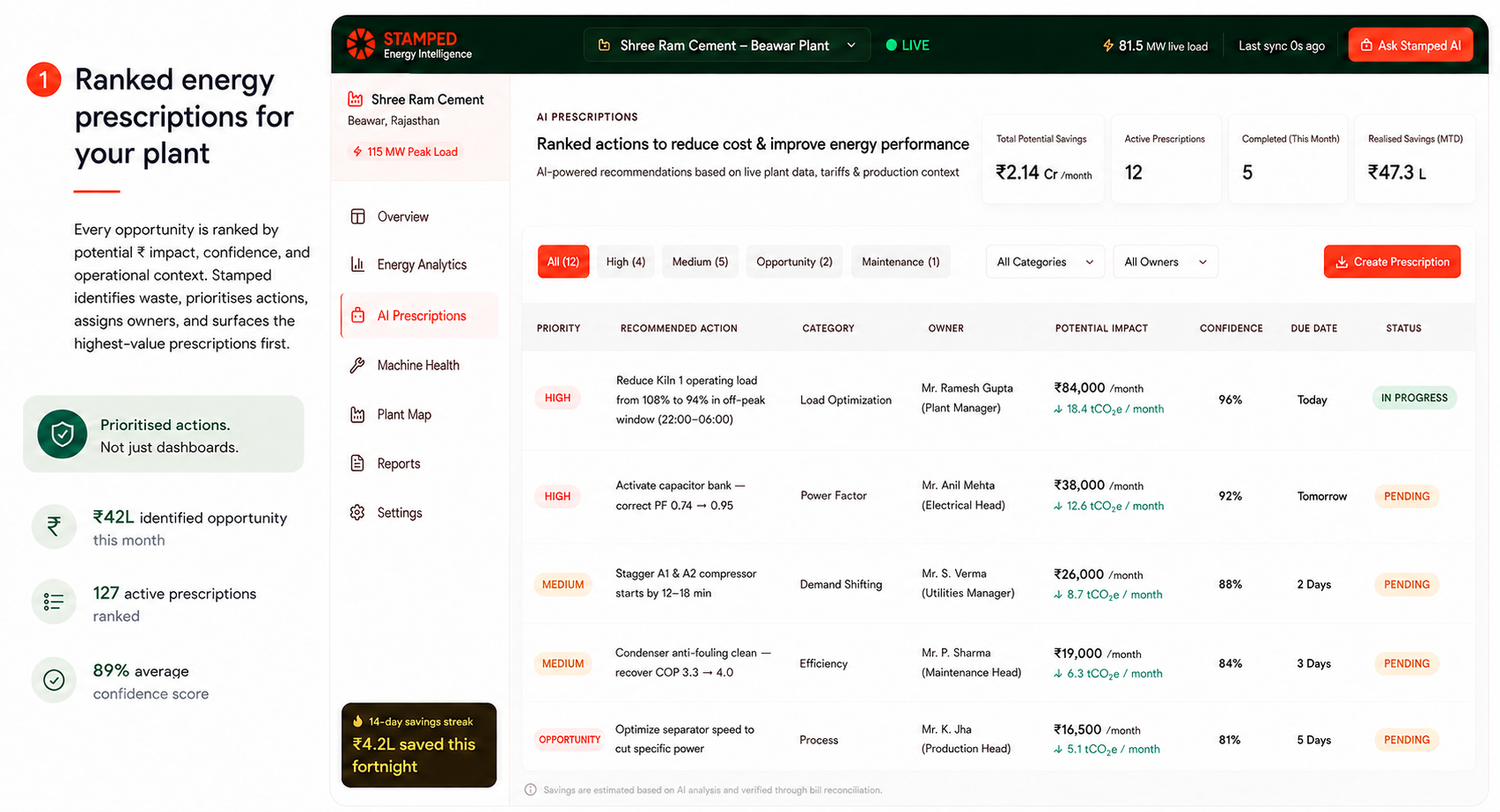
An energy decision layer is not a replacement for your DCS, historian, or EMS. It is the governance interface between plant data, operational roles, and financial outcomes.
It answers four leadership questions continuously:
What should change this week? A specific operational decision with context, not "energy is high."
Who owns it? Utilities, production, maintenance, or planning, not a shared inbox.
What is it worth? Rupee impact leadership recognizes before the bill closes.
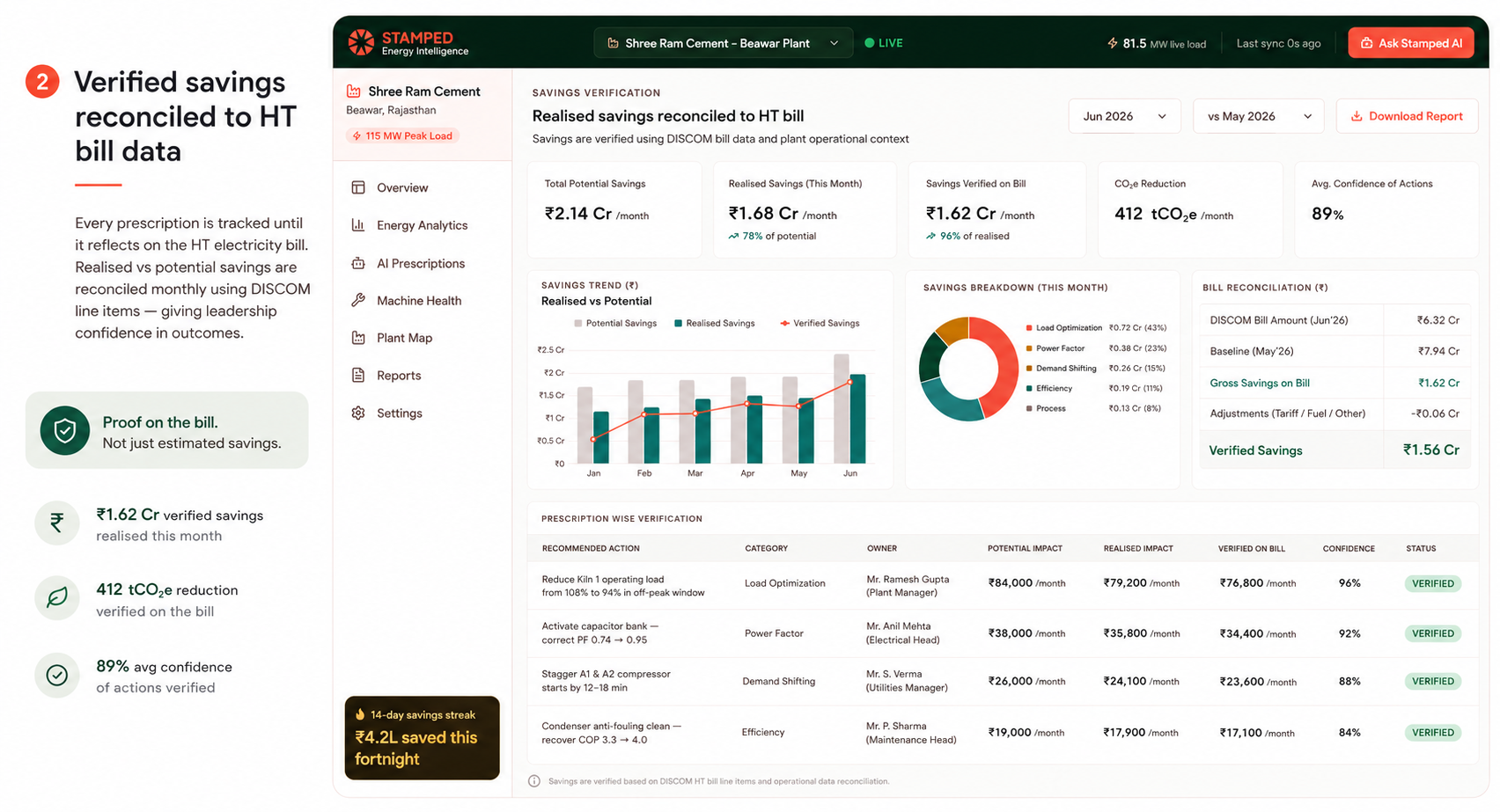
Did it work? Verification on the DISCOM statement and, where relevant, intensity trends for sustainability reporting.
Monitoring informs. A decision layer assigns, tracks, and verifies.
For large batch chemical operations, the highest-value decisions sit at the intersection of production scheduling, utility strategy, and tariff structure, not in a single piece of equipment.
The ROI case in rupees leadership can defend
Large chemical sites in the ₹50 lakh to ₹2 crore per month HT band cannot treat electricity as background cost. Tariffs, contract demand, time-of-use windows, and onsite generation make operational choices a material line item.
Reference benchmarks on comparable process-intensive plants in India suggest 12–20% electricity cost recovery when decisions are systematically assigned and verified. That is not a marketing guarantee. It is the band leadership should expect a disciplined program to explore.
Worked example: ₹50 lakh monthly HT bill
Scenario | Monthly savings | Annual savings |
|---|---|---|
Current spend | ₹50 lakh | ₹6 crore |
10% verified recovery | ₹5 lakh | ₹60 lakh |
15% verified recovery | ₹7.5 lakh | ₹90 lakh |
20% verified recovery | ₹10 lakh | ₹1.2 crore |
When contract demand, off-peak scheduling, and utility production coordination are in scope, outcomes often land toward the upper end of the band: roughly ₹80 lakh to ₹1.5 crore per year on a ₹50 lakh monthly bill, depending on plant mix and tariff structure.
That is the ROI story Stamped is built around: not estimated kWh deltas in a slide deck, but rupees reconciled to DISCOM line items each billing cycle.
Cost and sustainability in one ledger
Commercial and sustainability pressures used to sit in separate workstreams. At plant level, they meet on the same HT bill.
Leadership question | Monitoring-only answer | Decision-layer answer |
|---|---|---|
Why did cost spike? | Trend line and alarm history | Assigned actions linked to schedule and tariff context |
What should we do next? | Consultant deck or audit backlog | Prioritized queue with owners and due dates |
Did we save money? | Estimated kWh delta | Reconciliation to DISCOM bill line items |
Can we report it? | Difficult to audit | Realised vs potential ledger for governance review |
Scope 1 and 2 intensity targets, customer questionnaires, and ISO 14001 evidence require traceable plant outcomes, not narrative. A solar installation or one-off project is necessary. It is rarely sufficient to explain month-to-month performance.
The decision layer connects both: verified rupee recovery on the bill and documented operational improvement that rolls up to intensity metrics leadership already reports.
How Stamped Energy fits without disrupting OT
Stamped Energy is AI-powered prescriptive energy intelligence for energy-intensive manufacturing in India. We are built for sites that already have meters and systems, and need closure on top of them.
Connect to incomer data, DISCOM bills, and production context.
Observe patterns normalized to how your plant runs.
Decide on ranked prescriptions with rupee impact.
Execute by assigning actions to the roles that can act.
Verify on the next billing cycle.
Integration is read-only. We do not write to DCS or bypass your control philosophy.
Our chemical and paint vertical focuses on batch and continuous plants where utilities and production calendars interact. That is exactly where leadership decisions, not single-parameter tuning, drive outcomes.
What changes in the leadership meeting
When a decision layer is in place, the conversation shifts immediately. Leadership reviews a short list of decisions, their owners, and what last month's bill confirms. Finance sees rupees. Sustainability sees operational levers with audit-friendly documentation, not only project milestones.
Bottom line
Large chemical plants in India do not need convincing that energy or data matter. They need a decision-making layer that turns existing investment into assigned actions, financial accountability, and sustainability outcomes leadership can defend.
If your site already has the infrastructure and still reconciles performance only when the bill arrives, the next step is not another dashboard. It is a governed loop that proves results in rupees. On a ₹50 lakh monthly bill, that typically means ₹80 lakh to ₹1.5 crore per year to explore when decisions are owned and verified.
Book a discovery call to map your plant's decision layer on existing meters and bills.